" width="822.9999955138037px"><path d="M 174.502 118.706 C 169.592 118.706 165.604 117.936 162.549 116.377 C 159.493 114.828 157.288 112.581 155.935 109.632 C 154.583 106.685 153.901 103.068 153.901 98.762 L 153.901 9.443 L 179.301 9.443 L 179.301 93.676 C 179.301 95.774 179.803 97.172 180.804 97.871 C 181.807 98.572 183.059 98.921 184.562 98.921 L 189.372 98.921 L 189.372 118.706 L 174.492 118.706 Z M 271.596 59.423 C 268.89 52.179 264.471 46.514 258.369 42.417 C 252.257 38.32 244.441 36.271 234.922 36.271 C 226.896 36.271 219.913 37.991 213.951 41.438 C 207.989 44.885 203.359 49.781 200.053 56.125 C 196.746 62.471 195.093 70.094 195.093 78.987 C 195.093 87.181 196.697 94.375 199.903 100.57 C 203.109 106.765 207.738 111.581 213.8 115.028 C 219.863 118.476 227.197 120.204 235.824 120.204 C 242.738 120.204 248.84 119.105 254.161 116.907 C 259.471 114.709 263.83 111.641 267.237 107.684 C 270.634 103.737 272.738 99.022 273.549 93.525 L 249.351 93.525 C 248.65 95.824 247.167 97.692 244.912 99.141 C 242.658 100.59 239.632 101.319 235.824 101.319 C 232.607 101.319 229.812 100.64 227.407 99.292 C 225.003 97.942 223.169 95.974 221.917 93.376 C 220.664 90.778 220.043 87.68 220.043 84.084 L 274.15 84.084 C 275.143 74.89 274.301 66.677 271.596 59.424 Z M 220.173 68.646 C 220.273 66.308 220.774 64.259 221.696 62.5 C 222.862 60.239 224.662 58.364 226.876 57.105 C 229.131 55.805 231.816 55.156 234.922 55.156 C 237.828 55.156 240.383 55.756 242.587 56.956 C 244.792 58.154 246.496 59.873 247.698 62.121 C 248.64 63.88 249.151 66.057 249.231 68.646 Z M 360.562 100.87 C 359.361 100.87 358.438 100.49 357.787 99.741 C 357.136 98.991 356.805 97.772 356.805 96.074 L 356.805 66.397 C 356.805 61.601 356.084 57.325 354.631 53.578 C 353.178 49.831 350.994 46.684 348.088 44.135 C 345.182 41.587 341.575 39.639 337.266 38.29 C 332.957 36.941 327.897 36.271 322.086 36.271 C 314.471 36.271 307.838 37.451 302.177 39.789 C 296.515 42.137 292.127 45.465 289.021 49.761 C 285.914 54.057 284.361 59.003 284.361 64.599 L 309.16 64.599 C 309.16 62.801 309.642 61.252 310.593 59.953 C 311.545 58.654 312.847 57.624 314.501 56.875 C 316.154 56.126 318.178 55.756 320.584 55.756 C 322.587 55.756 324.421 56.026 326.074 56.576 C 327.728 57.125 329.03 58.104 329.982 59.503 C 330.934 60.902 331.404 62.801 331.404 65.199 L 331.404 71.193 L 316.375 71.193 C 311.164 71.193 306.455 71.743 302.247 72.842 C 298.038 73.942 294.461 75.609 291.505 77.859 C 288.549 80.106 286.265 82.865 284.661 86.102 C 283.059 89.349 282.256 93.076 282.256 97.273 C 282.256 104.067 284.591 109.513 289.25 113.61 C 293.91 117.706 300.192 119.754 308.108 119.754 C 313.519 119.754 318.529 118.675 323.138 116.527 C 327.747 114.379 331.004 111.562 332.908 108.064 L 333.81 108.064 C 334.912 111.461 336.946 114.079 339.902 115.927 C 342.857 117.776 346.685 118.706 351.395 118.706 L 364.02 118.706 L 364.02 100.87 Z M 331.404 92.477 C 331.104 95.774 329.732 98.322 327.277 100.121 C 324.822 101.919 321.735 102.818 318.028 102.818 C 315.022 102.818 312.597 102.119 310.744 100.72 C 308.89 99.321 307.958 97.373 307.958 94.875 C 307.958 93.076 308.489 91.497 309.541 90.148 C 310.593 88.799 312.116 87.75 314.12 87.001 C 316.124 86.252 318.629 85.882 321.635 85.882 L 331.404 85.882 L 331.404 92.476 Z M 380.262 118.706 L 380.262 58.005 L 367.937 58.005 L 367.937 37.62 L 380.262 37.62 L 380.262 30.876 C 380.262 23.983 382.437 18.686 386.795 14.989 C 391.153 11.292 397.335 9.443 405.362 9.443 L 422.345 9.443 L 422.345 26.08 L 412.126 26.08 C 410.021 26.08 408.418 26.529 407.315 27.429 C 406.213 28.329 405.663 29.927 405.663 32.226 L 405.663 37.62 L 421.144 37.62 L 421.144 58.005 L 405.663 58.005 L 405.663 118.706 Z M 106.026 15.368 C 85.916 -1.778 56.367 -5.355 32.138 8.595 C 18.892 16.228 9.394 27.848 4.302 41.067 C 17.71 52.497 37.409 54.876 53.561 45.583 L 106.036 15.378 Z M 85.675 124.49 C 110.625 115.698 128.501 91.967 128.501 64.069 C 128.501 48.812 123.15 34.803 114.212 23.791 C 97.579 29.657 85.665 45.475 85.665 64.069 L 85.665 124.49 Z M 1.077 52.358 C -3.763 78.299 7.91 105.606 32.139 119.554 C 44.861 126.911 59.733 129.667 74.253 127.358 C 77.479 110.063 69.694 91.867 53.551 82.564 L 1.077 52.359 Z" fill="rgb(0, 0, 0)" height="128.15340659356372px" id="WIxjterlR" width="422.3454675184448px"/><path d="M 32.135 110.645 C 27.23 110.645 22.825 110.046 18.921 108.848 C 15.016 107.651 11.662 106.003 8.86 103.908 C 6.057 101.711 3.905 99.116 2.403 96.122 C 0.901 93.028 0.1 89.634 0 85.94 L 12.013 85.94 C 12.213 89.434 13.164 92.379 14.866 94.774 C 16.668 97.07 19.071 98.767 22.074 99.865 C 25.178 100.963 28.631 101.512 32.435 101.512 C 38.542 101.512 43.198 100.364 46.401 98.068 C 49.704 95.773 51.356 92.529 51.356 88.336 C 51.356 85.143 50.656 82.697 49.254 80.999 C 47.852 79.203 45.7 77.806 42.797 76.808 C 39.894 75.809 36.089 74.961 31.384 74.262 C 24.877 73.364 19.471 72.116 15.166 70.52 C 10.862 68.922 7.608 66.676 5.405 63.782 C 3.203 60.788 2.102 56.895 2.102 52.103 C 2.102 47.512 3.354 43.519 5.856 40.125 C 8.359 36.632 11.863 33.937 16.368 32.04 C 20.873 30.044 26.129 29.046 32.135 29.046 C 38.242 29.046 43.498 30.044 47.902 32.04 C 52.307 33.937 55.761 36.682 58.264 40.276 C 60.767 43.769 62.068 47.961 62.169 52.852 L 50.305 52.852 C 50.105 49.359 49.204 46.564 47.603 44.467 C 46.101 42.271 43.998 40.725 41.295 39.827 C 38.692 38.828 35.589 38.33 31.985 38.33 C 26.379 38.33 22.024 39.477 18.921 41.773 C 15.818 44.068 14.265 47.112 14.265 50.906 C 14.265 53.8 15.016 56.145 16.518 57.943 C 18.02 59.639 20.322 60.987 23.425 61.985 C 26.629 62.883 30.633 63.682 35.439 64.38 C 41.346 65.179 46.401 66.377 50.605 67.974 C 54.91 69.571 58.164 71.916 60.366 75.011 C 62.568 78.005 63.67 82.097 63.67 87.289 C 63.67 92.279 62.369 96.521 59.766 100.014 C 57.163 103.408 53.459 106.053 48.653 107.95 C 43.949 109.747 38.443 110.645 32.135 110.645 Z M 80.657 109.148 L 80.657 30.544 L 92.82 30.544 L 92.82 109.148 Z M 86.964 17.068 C 84.662 17.068 82.81 16.469 81.408 15.272 C 80.006 13.974 79.306 12.278 79.306 10.18 C 79.306 8.084 80.006 6.438 81.408 5.24 C 82.81 4.042 84.662 3.443 86.964 3.443 C 89.166 3.443 90.969 4.042 92.37 5.24 C 93.771 6.438 94.473 8.084 94.473 10.181 C 94.473 12.277 93.771 13.974 92.37 15.272 C 90.969 16.469 89.166 17.068 86.964 17.068 Z M 127.919 134.152 C 120.912 134.152 115.505 132.655 111.701 129.66 C 107.897 126.666 105.995 122.773 105.995 117.982 C 105.995 114.289 107.146 110.895 109.449 107.801 C 111.752 104.607 114.904 101.812 118.909 99.416 L 118.909 98.817 C 116.606 97.719 114.855 96.222 113.653 94.325 C 112.452 92.428 111.851 90.333 111.851 88.037 C 111.851 84.743 113.052 81.749 115.455 79.053 C 117.858 76.258 120.961 73.764 124.766 71.568 L 130.472 75.16 C 127.969 76.458 126.017 77.955 124.615 79.652 C 123.214 81.25 122.513 82.997 122.513 84.892 C 122.513 87.188 123.364 88.935 125.066 90.133 C 126.768 91.231 128.97 91.78 131.673 91.78 L 155.099 91.78 C 163.808 91.78 170.316 93.676 174.62 97.47 C 178.925 101.163 181.077 106.153 181.077 112.442 C 181.077 116.934 179.976 120.777 177.774 123.97 C 175.672 127.265 172.668 129.759 168.764 131.456 C 164.96 133.254 160.405 134.152 155.099 134.152 Z M 130.321 124.719 L 154.047 124.719 C 159.053 124.719 162.757 123.671 165.16 121.575 C 167.563 119.479 168.764 116.784 168.764 113.49 C 168.764 109.198 167.513 106.203 165.01 104.506 C 162.507 102.809 159.103 101.962 154.798 101.962 L 124.165 101.962 C 121.762 103.658 119.91 105.704 118.608 108.1 C 117.307 110.396 116.657 112.691 116.657 114.987 C 116.657 118.081 117.858 120.477 120.26 122.174 C 122.764 123.871 126.117 124.719 130.321 124.719 Z M 142.936 79.653 C 136.928 79.653 131.623 78.604 127.017 76.509 C 122.413 74.312 118.859 71.318 116.356 67.525 C 113.853 63.732 112.602 59.34 112.602 54.349 C 112.602 49.359 113.853 44.966 116.356 41.174 C 118.859 37.38 122.413 34.436 127.017 32.34 C 131.623 30.144 136.928 29.046 142.936 29.046 C 149.043 29.046 154.348 30.144 158.853 32.34 C 163.358 34.436 166.862 37.38 169.365 41.174 C 171.968 44.966 173.269 49.358 173.269 54.349 C 173.269 59.34 171.968 63.732 169.365 67.525 C 166.862 71.318 163.358 74.312 158.853 76.509 C 154.348 78.604 149.043 79.652 142.936 79.652 Z M 142.936 71.867 C 148.942 71.867 153.547 70.22 156.751 66.926 C 159.954 63.532 161.557 59.34 161.557 54.35 C 161.557 49.258 159.905 45.116 156.6 41.921 C 153.397 38.628 148.842 36.981 142.936 36.981 C 136.928 36.981 132.324 38.628 129.12 41.922 C 125.916 45.216 124.315 49.358 124.315 54.349 C 124.315 59.44 125.916 63.632 129.12 66.925 C 132.424 70.22 137.029 71.867 142.936 71.867 Z M 161.256 37.58 L 156.751 34.886 C 159.154 28.398 162.407 23.556 166.512 20.362 C 170.616 17.068 175.622 15.571 181.528 15.871 L 181.528 25.453 C 178.725 25.154 176.122 25.403 173.719 26.201 C 171.317 26.999 169.065 28.347 166.962 30.244 C 164.96 32.14 163.057 34.585 161.256 37.58 Z M 194.359 109.148 L 194.359 30.544 L 205.922 30.544 L 206.372 46.862 L 207.273 46.862 C 209.675 41.073 213.379 36.732 218.385 33.837 C 223.391 30.843 228.847 29.346 234.753 29.346 C 238.858 29.346 242.612 29.945 246.016 31.142 C 249.52 32.34 252.523 34.286 255.026 36.981 C 257.629 39.676 259.631 43.17 261.032 47.462 C 262.433 51.654 263.135 56.794 263.135 62.883 L 263.135 109.148 L 250.971 109.148 L 250.971 65.28 C 250.971 59.39 250.22 54.549 248.719 50.756 C 247.317 46.963 245.115 44.168 242.111 42.371 C 239.208 40.475 235.454 39.526 230.849 39.526 C 225.944 39.526 221.638 40.725 217.935 43.121 C 214.231 45.516 211.377 48.76 209.375 52.852 C 207.373 56.844 206.372 61.436 206.372 66.627 L 206.372 109.148 Z M 304.121 110.345 C 296.413 110.345 290.156 108.349 285.351 104.357 C 280.646 100.265 278.292 94.875 278.292 88.187 C 278.292 84.394 279.043 81 280.545 78.005 C 282.047 74.911 284.199 72.316 287.002 70.219 C 289.806 68.023 293.209 66.427 297.213 65.429 C 301.218 64.331 305.723 63.782 310.729 63.782 L 331.301 63.782 L 331.301 71.867 L 312.53 71.867 C 307.826 71.867 303.82 72.466 300.517 73.663 C 297.314 74.861 294.861 76.657 293.16 79.053 C 291.457 81.349 290.606 84.145 290.606 87.438 C 290.606 91.73 292.108 95.174 295.111 97.769 C 298.215 100.265 302.32 101.512 307.425 101.512 C 312.83 101.512 317.486 100.314 321.39 97.919 C 325.395 95.423 328.198 91.979 329.799 87.588 L 329.799 55.398 C 329.799 51.604 329.099 48.51 327.698 46.115 C 326.396 43.619 324.394 41.823 321.69 40.725 C 319.087 39.526 315.834 38.927 311.929 38.927 C 308.126 38.927 304.822 39.526 302.019 40.725 C 299.216 41.922 297.014 43.569 295.411 45.666 C 293.81 47.662 292.909 50.058 292.709 52.852 L 280.695 52.852 C 280.796 48.16 282.197 44.018 284.901 40.425 C 287.603 36.831 291.308 34.037 296.012 32.04 C 300.818 30.044 306.324 29.047 312.53 29.047 C 317.336 29.047 321.54 29.644 325.144 30.843 C 328.848 32.04 331.902 33.788 334.305 36.082 C 336.807 38.278 338.71 41.024 340.011 44.317 C 341.313 47.612 341.963 51.454 341.963 55.847 L 341.963 91.331 C 341.963 94.325 342.463 96.471 343.465 97.769 C 344.465 99.066 346.018 99.715 348.119 99.715 L 352.325 99.715 L 352.325 109.148 L 344.816 109.148 C 340.611 109.148 337.408 108.1 335.206 106.003 C 333.003 103.908 331.652 100.863 331.151 96.871 L 330.55 96.871 C 328.348 101.062 324.844 104.357 320.039 106.753 C 315.334 109.148 310.028 110.345 304.121 110.345 Z M 380.402 109.148 C 377.098 109.148 374.345 108.649 372.143 107.651 C 369.94 106.553 368.288 104.955 367.187 102.86 C 366.186 100.763 365.685 98.119 365.685 94.924 L 365.685 0 L 377.849 0 L 377.849 92.379 C 377.849 94.875 378.4 96.621 379.501 97.619 C 380.702 98.518 382.304 98.967 384.306 98.967 L 390.313 98.967 L 390.313 109.148 Z" fill="rgb(251, 94, 72)" height="134.15168025939215px" id="aue9N0zoO" transform="translate(432.687 9.848)" width="390.31255654895995px"/></g></svg>)
Google turned your ROAS target into a ceiling
Leaf Signal

Over the last few weeks we've been seeing some odd behaviour across Google Ads accounts. Efficiency sliding on campaigns nobody had touched. Conversion volume down while spend sat flat. Brand campaigns quietly losing reach for no reason anyone could point at.
It traces back to a change Google made on 17 August, to how target-based bid strategies behave on budget-constrained campaigns. The rollout finished on the 27th. Because bidding changes take weeks to fully express, the damage mostly surfaced around 10 September — three weeks downstream of the cause, which is why a lot of teams are still looking in the wrong place.
You may already have spotted it. You may have seen the numbers dip and reasonably put it down to September being September. Either way it's worth twenty minutes to check, because the fix is straightforward and the run-up to Black Friday is not the time to find out the hard way.
Here's what changed, how to check your own account, and what to do before peak.
What changed
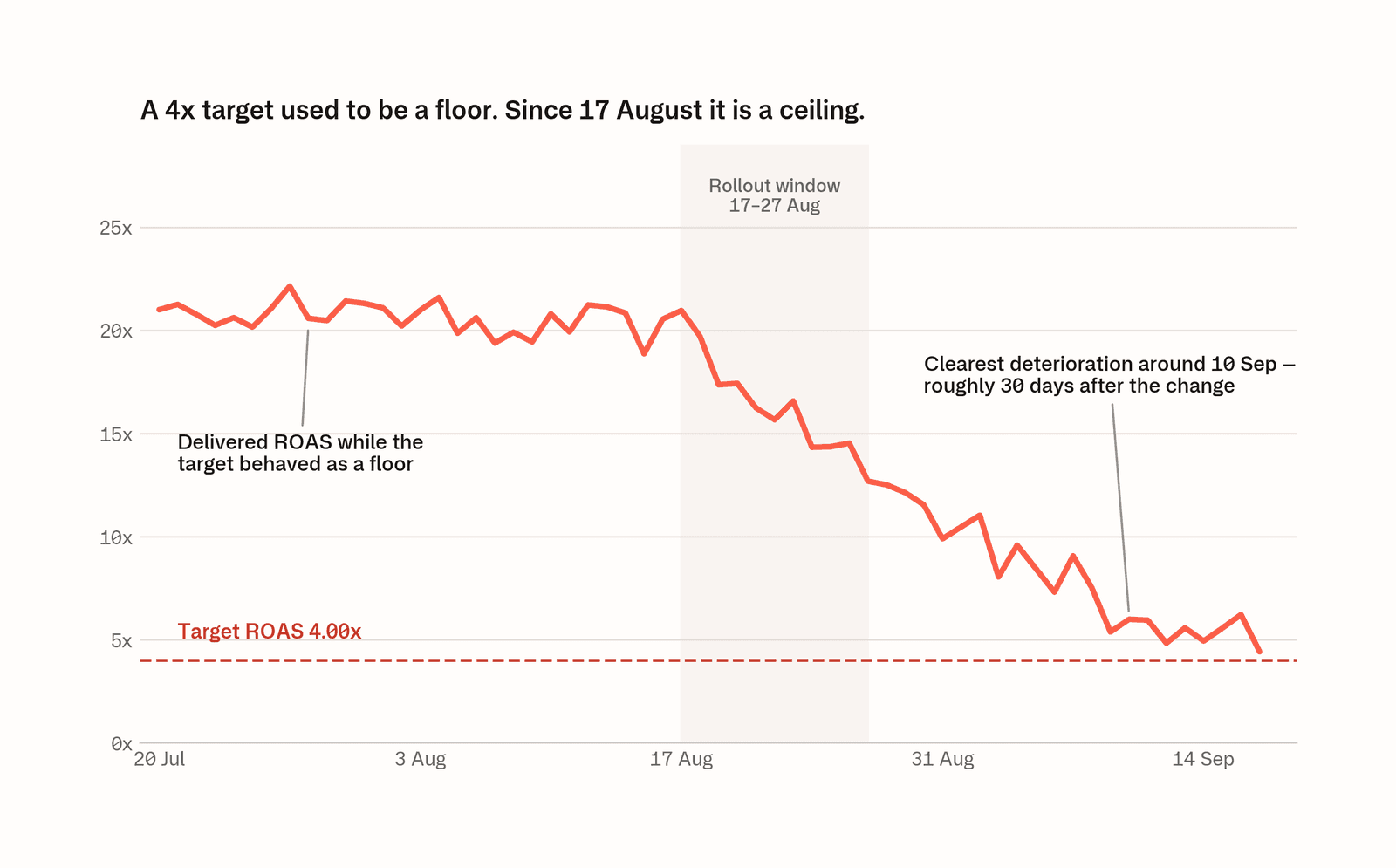
Before 17 August, a campaign flagged "Limited by budget" and running Target ROAS or Target CPA treated its target as a soft goal. It bid into the most efficient demand it could find, ran out of budget, and stopped. Which is why targets were routinely smashed. A brand campaign set at 4x tROAS could return 18–24x quite happily, because there was never enough budget left to go and buy the marginal traffic that would have dragged the average down to 4x.
Now Google optimises toward the number you typed in, whether the budget constrains the campaign or not. Google's own example: if your Target CPA is $10 and your actual CPA is $5, the campaign "now delivers more closely to a $10 actual CPA."
Read that again, because it's the whole thing. The target is enforced in both directions now. If you set it as a floor, it's a ceiling.
Drawn out, it looks like this. The shape is illustrative rather than one specific account, but it's the pattern that keeps repeating.
In scope: Target CPA and Target ROAS on Search, Shopping, Performance Max, Demand Gen and Travel, plus Target CPC for Demand Gen, across Google Ads, Search Ads 360 and Display & Video 360. Out of scope: App, Video reach, Video view. Display and Hotel already worked this way. If a campaign was never budget-constrained, none of this touches it.
Google changed nobody's targets or budgets. It shipped the behaviour to live accounts and left the correcting to advertisers.
Why it took three weeks to show up
Three things conspired here, and they're worth understanding because they're the reason this gets misdiagnosed.
The rollout ran from 17 to 27 August, so the cliff edge sits on a different day in every account, which kills the obvious "what changed on the 17th?" instinct. Smart Bidding then has to relearn, and a change this size takes around 30 days to fully express, so what you see is a slope rather than a step. And it compounds: lower bids buy fewer impressions, which produce fewer clicks and fewer conversions, which the model reads as a smaller opportunity, so it bids lower still.
Put those together and a change made in mid-August does its clearest damage in the second week of September, looking for all the world like seasonality, creative fatigue, or something you broke.
What it looks like in a real account
Here's the case of a health and beauty brand. All 14 live campaigns, nothing excluded, 20 July – 16 August against 17 August – 13 September.
Spend was flat: +0.7%. Conversion value fell 40.5%. Account ROAS went from 7.53x to 4.45x.
Same money in, 40% less value out. That's the sentence that makes the phone ring.
One caveat on those figures and the portfolio numbers further down: post-period conversions were still maturing when we pulled the data, so if anything this overstates the fall. We'd rather publish the worst-case read than sit on it for another fortnight.
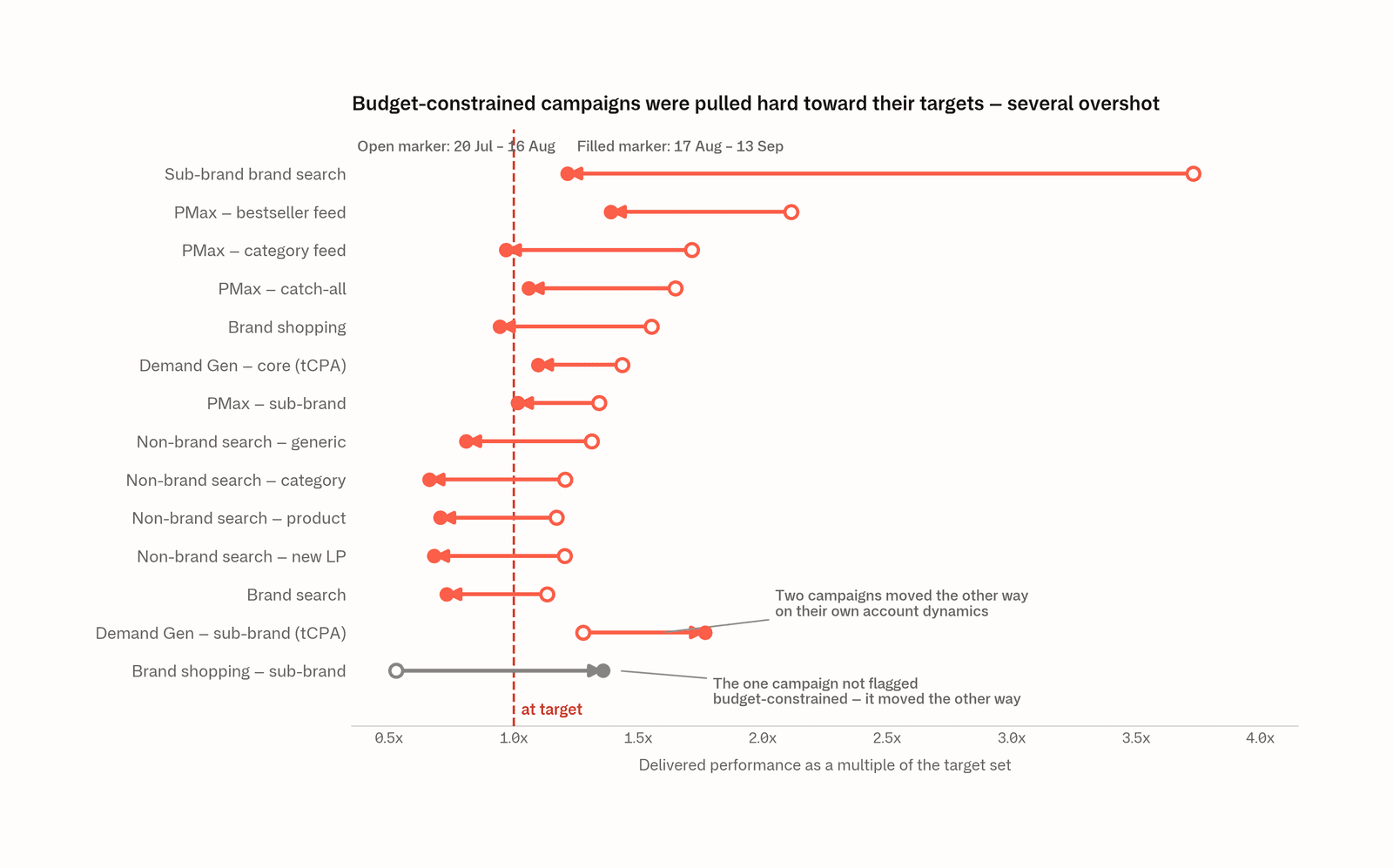
Plot each campaign as delivered performance divided by the target set and you can see exactly what the system did. Before the change, campaigns sat anywhere from 1.1x to 3.7x above the targets they'd been given. After it, most of them collapsed onto the 1.0 line. Demand Gen campaigns are shown as target CPA divided by actual CPA, so the direction reads the same way as the ROAS campaigns.
The size of the fall tracked the size of the gap, every time. One sub-brand brand search campaign had been delivering 3.7x its target — Google took the budget it had been sitting on and spent it buying down toward that target. Spend up 134%, ROAS down 67%. Campaigns already running close to their targets barely noticed.
Worth knowing before you panic: several campaigns overshot. Brand search went from 1.13x its target to 0.73x, and two non-brand campaigns ended up delivering at about two-thirds of what they'd been asked for. The correction carries past the mark while the model relearns. It's the reason Google's advice to wait one to two conversion cycles is worth taking rather than ignoring.
The most useful row in that chart is the campaign that wasn't flagged budget-constrained. It moved the other way entirely, 0.53x target to 1.36x. Same account, same tracking, same trading conditions, same fortnight. If measurement had broken, that campaign would have gone down with the rest of them. It didn't, and that's what tells you this is a bidding change rather than a tracking one.
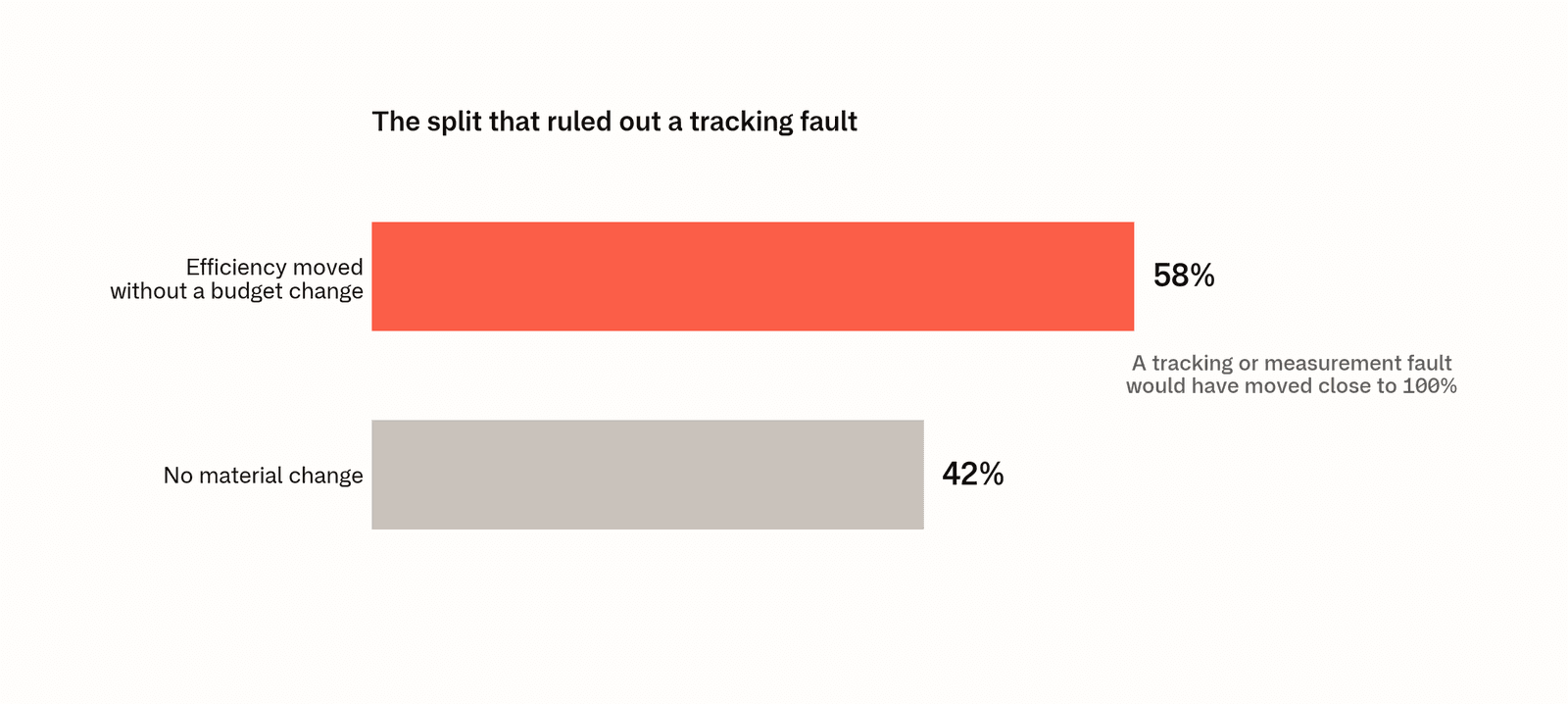
The wider Signal portfolio says the same thing. Roughly half of those accounts had targets configured at all, and within that group just under 60% saw efficiency move without a deliberate budget change. The other 40% carried on as normal. Same caveat as above — provisional, and a worst-case read. A tracking fault takes down close to 100% of accounts. A bidding change only touches the ones carrying a gap between target and actual.
That distinction matters more than it sounds. If you conclude this is a measurement problem, you'll spend a fortnight in your tag setup while the actual cause carries on throttling your campaigns.
How to check your own account
Don't take our word for any of it. If you've got a Google Ads MCP connected to Claude, or any agent with Google Ads API access, paste this in and you'll know inside a minute.
One line in there will save you more time than the rest put together. In the account above, 12 of the 14 campaigns carried their target on maximize_conversion_value.target_roas or maximize_conversions.target_cpa_micros. Only two used the pure Target ROAS strategy.
So if you check the obvious fields, or scan down the bid strategy column looking for rows that say "Target ROAS", you'll find two campaigns, decide you got off lightly, and be wrong by an order of magnitude. Maximise conversion value with a target ROAS is a target-based strategy. It's in scope, and it's easy to miss.
The other field to watch is primary_status_reasons. BUDGET_CONSTRAINED is what puts a campaign in the affected group, and it's also what separates this from a tracking problem, which is the whole job of step three in that prompt. Run it across a few accounts and the pattern either shows up or it doesn't.
If you're a brand, here's the order we'd work in
The first three steps exist so the fourth one doesn't send you chasing the wrong thing. It's tempting to skip straight to changing targets. Resist it for an afternoon.
Start by isolating the population. Campaigns that were "Limited by budget" in the 30 days before 17 August and running a target-based strategy, including the maximise-with-a-target variants. Everything else is a separate conversation.
Then compare like for like. Baseline 20 July – 16 August against 17 August onward. What you're looking for is efficiency that moved without anyone deliberately changing the budget. If spend scaled 40% or more and conversions climbed with it, that's diminishing returns doing its normal job, not this.
Rule out the confounders before you act. Tracking breakage, a consent platform migration, a promo calendar difference, plain September seasonality. Your unaffected campaigns are the control group and they're free — use them. If everything moved, this isn't your problem and you should keep looking.
Then audit the gap, and fix worst-first. Pull actual performance for the 28 days before 17 August, set it against the target that's configured, and rank by the size of the gap. Raise targets to recent actuals, or take them off brand campaigns altogether. Brand is where the measured return is most inflated and where a hard target hurts most. Google's Bid Target Adjustment Tool will do the arithmetic for you, behind the "Review your campaign targets" banner or under campaign settings via Bidding, then Review campaigns. It won't suggest anything for campaigns with fewer than seven conversions, so those are on you.
Three ways to get this wrong.
Don't rebuild campaigns. Google draws on 90 days of history and sometimes a full year. Rebuilding throws it away at the exact moment you need the model to recover quickly.
Give your budgets room. This only bites budget-constrained campaigns, so taking off the constraint takes you out of the affected group entirely. Keep daily budget comfortably above average daily spend and a lot of this stops being your problem.
If you run portfolio bid strategies or shared budgets, make the changes at that level. Campaign-level edits won't hold, and it's an easy hour to lose.
Then leave it alone for one to two conversion cycles before you judge it. Genuinely leave it alone.
If you're an agency, the job is a bit different
Everything above still applies per account. At portfolio scale, three things change.
Triage by exposed spend, not by whoever's shouting. The loudest client usually isn't the most exposed one. Run the diagnostic across the book and rank by the spend sitting inside budget-constrained campaigns that were delivering above target. That's the number that tells you where the hours go. The concentration can be brutal inside a single account — in two accounts in the Signal portfolio, the share of campaigns running targets tighter than actual performance was 72% and 86%.
Split affected from unaffected before you touch anything. When several accounts degrade in the same fortnight, every instinct says shared cause: a tracking release, a consent platform update, a container change. It's the most expensive wrong turn available here. If every account moved, it isn't this. If the ones carrying target gaps moved and the rest held steady, it is.
Get to the client before the monthly report, not inside it. On a month-end deck this looks precisely like an agency that's dropped the ball: efficiency down, volume down, spend flat. There's no version of that meeting that goes well if the client sees the number before they hear the explanation. Lead with the diagnostic, the control group, and what you're doing about it. The performance-to-target chart is the one to put up, because it shows a mechanism rather than a mistake.
Two practical notes. Accounts running through Search Ads 360 won't see the Bid Target Adjustment Tool in Google Ads at all — it's behind the "Review bid strategies" banner in SA360 instead. And where you don't control the budget decision, put the budget-headroom recommendation in writing now. It's the structural fix, and it needs a client to say yes to it.
The bit that doesn't go away
Here's what's really changed, underneath the immediate mess.
Under the old behaviour, incomplete conversion data cost you efficiency at the margin. The bid strategy worked with a partial picture, you absorbed some wasted spend, and the budget constraint hid a lot of it.
Under a hard target, incomplete conversion data throttles delivery. Google optimises against the conversions it can see. When a decent share never arrive — consent loss, blocked client-side tags, broken event mapping, poor match rates — your measured ROAS sits below commercial reality. The system reads that as missing the target and cuts bids to close a gap that only exists in the data.
So you pay twice. Once for the conversions you never recorded, and again for the delivery Google pulls back to compensate.
For most brands this isn't hypothetical. We audited conversion tracking across 500 of the UK's biggest Shopify brands for the UK State of Tracking Report 2026: 98% had at least one critical tracking issue across Meta, Google Ads or GA4, and 52% were failing to track core events on their own site — the exact events a bid strategy optimises against. That 52% is the number that matters here. Those are brands whose targets are now being enforced against a systematically incomplete picture of what's actually converting. You can read the summary here or download the full report.
Before 17 August, under-measurement was a reporting problem you could work around. Now it's an execution problem you can't. Setting a hard target on top of partial event coverage is asking the system to optimise toward a number you already know is wrong.
Before Black Friday
This is the part worth acting on this month rather than next.
Your ROAS improves during peak — higher intent, better conversion rates, stronger AOV. Which means a target set at business-as-usual performance will throttle your campaigns at precisely the moment they're at their best. You get held at your November average while the auction is offering you the strongest week of your year.
The curve below is illustrative and your own peak shape will differ, but the shaded area is the part a business-as-usual target won't let you keep.
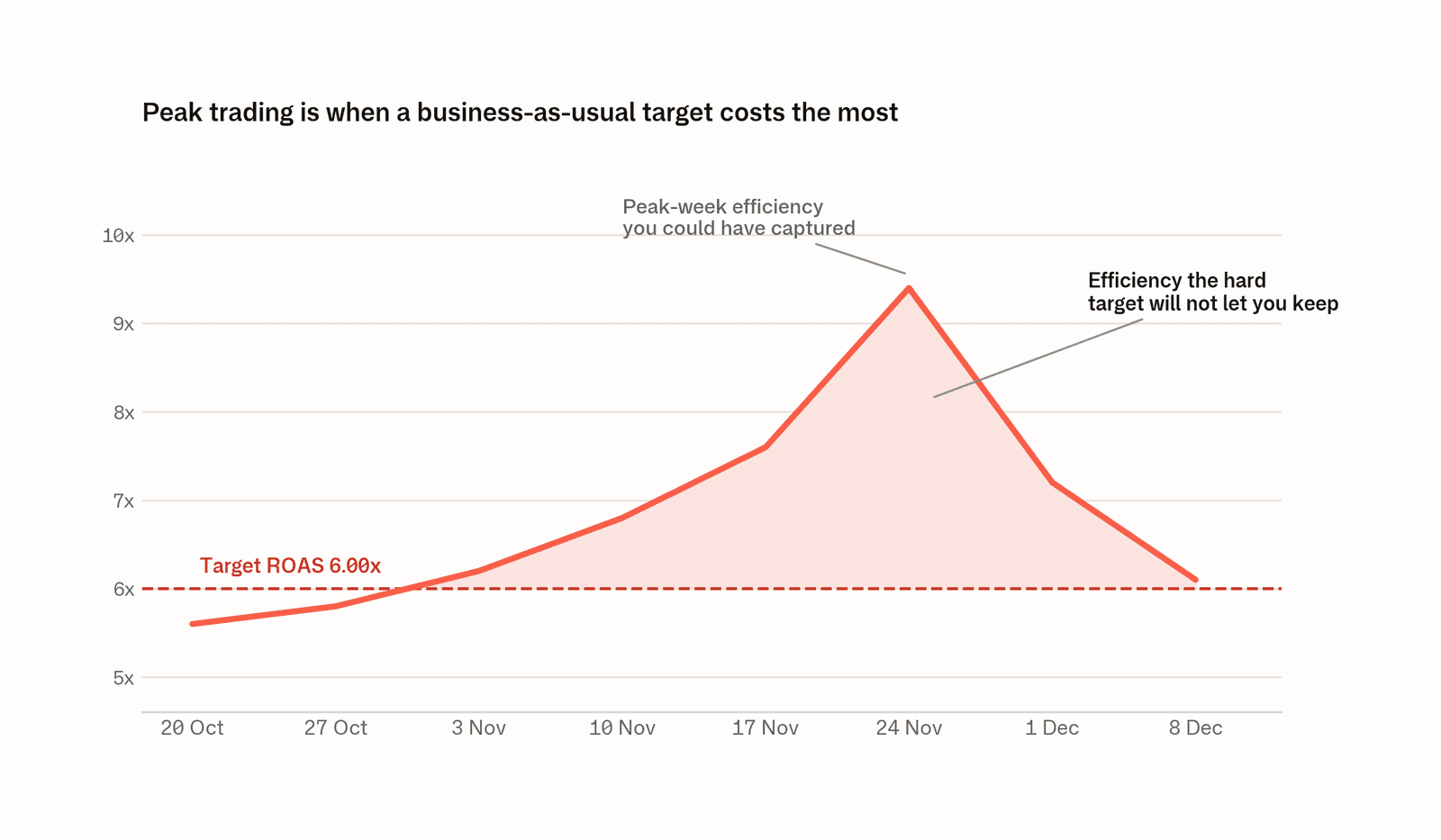
Set targets above what you expect to hit in peak, not at it. If you're expecting 6–8x through Black Friday week, put 10x in and let the campaign find its own ceiling. Do it in late October rather than the week before, because relearning costs days you can't spare in November — and as that account showed, the correction can overshoot before it settles.
And check your conversion tracking before you touch any of it. Under the new behaviour, a hard target sitting on top of incomplete event data is an instruction to throttle your best week of the year.
Google has taken away a bit of accidental upside that a lot of accounts had quietly been living on. Hard to argue it's wrong to make campaigns deliver what you asked them for. But it does mean your target is a live commercial input now rather than a safety rail, and the quality of the conversion data sitting underneath it decides whether the system delivers your intent or a distorted version of it.
If you inherited your targets from whoever built the account, they were almost certainly set as a floor and then forgotten about. Go and look at them this week. They're ceilings now.